
Years Ago, On The Foothills Of The Himalaya, Kashmir II
2nd day, time of plenty
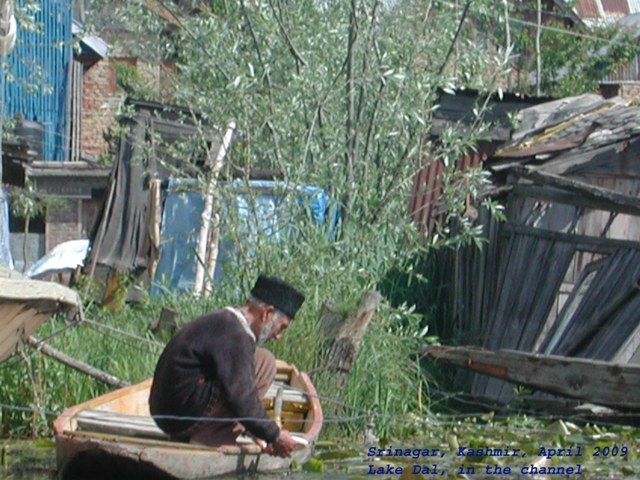
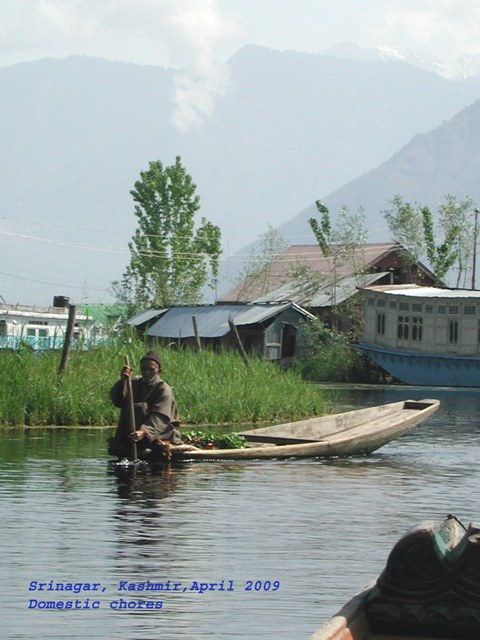
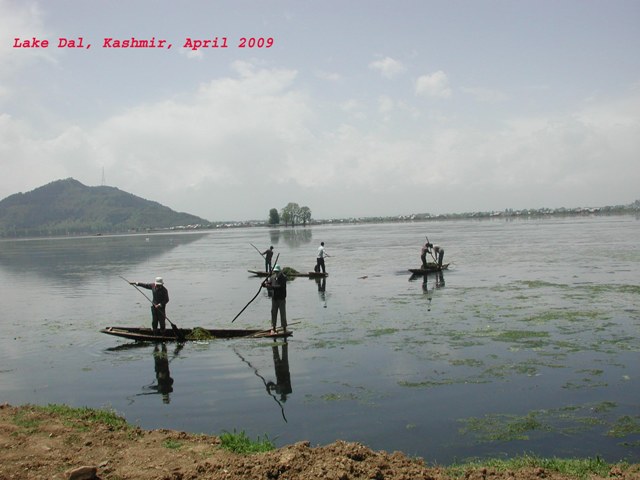
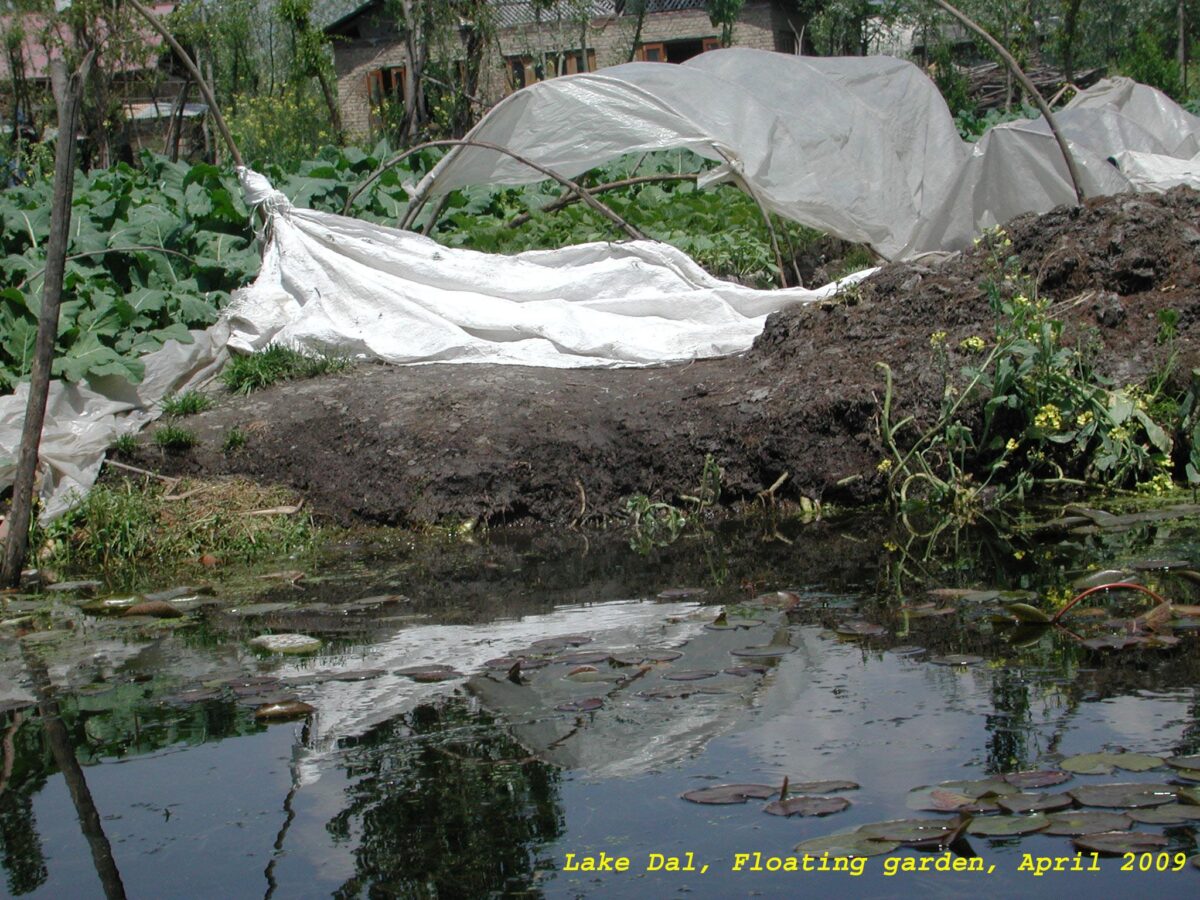
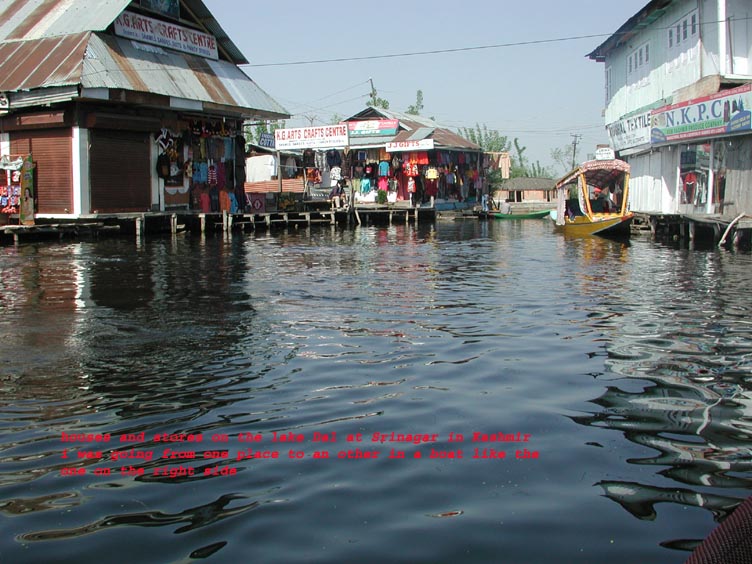
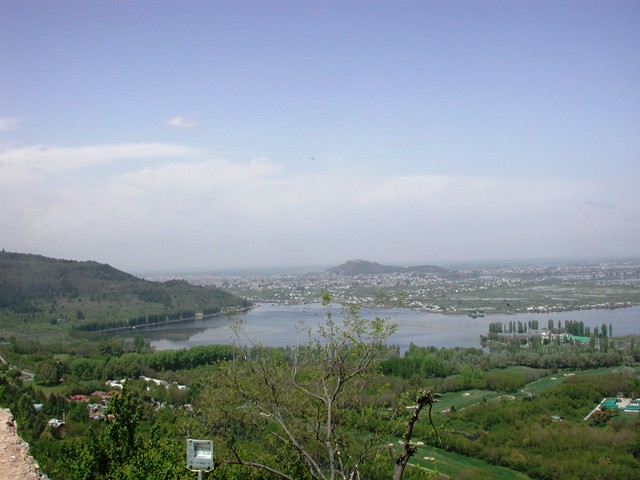
Early the next morning, we went ballistic—like an overzealous city officer paid by the number of tickets he handed out. I was dashing out alone, Lothar went into mountains to bother the tribal people. After a hefty breakfast I ‘sailed’ on a shikara skiff to visit (hope breeds fools ) some workshops. I like to see craftsmen in action and inhale the pungent scent of freshly worked up materials and of the craft shop itself.The tourist job is not a joke, especially when one wants to make 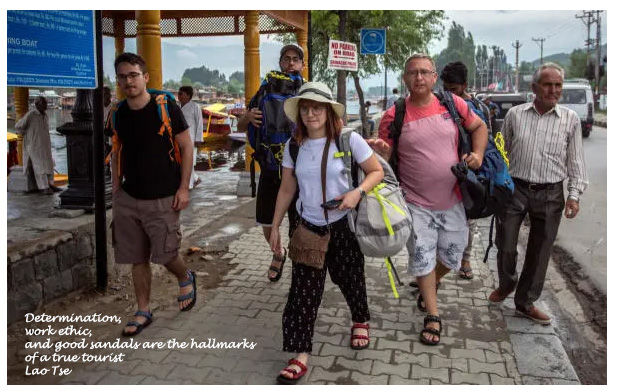 discoveries. I have a gut feeling we’re going to overdo it—fall into a kind of goat syndrome—and run all over the city. But who has time to think, to weigh, to choose? We’re in a full-on banzai mood! Let’s check around. The lake looks gorgeous and important. Of course, is a world-famous symbol, a means of connection between people, a great source of income, a cheap shipping network, a provider of dwelling accommodation for the very poor and the filthy rich, the greatest tourist attraction of the country, a veteran hydroponic farm and a powerful ecological lung for the whole valley continuously threatened to become a cesspool if people will not etc…. The water depth is lower than human size, but i
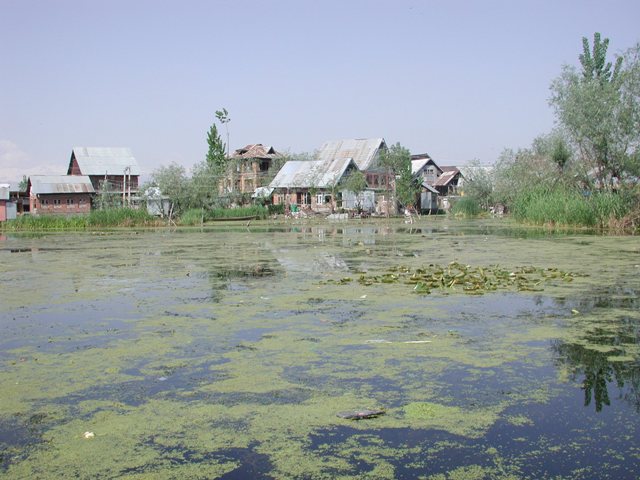
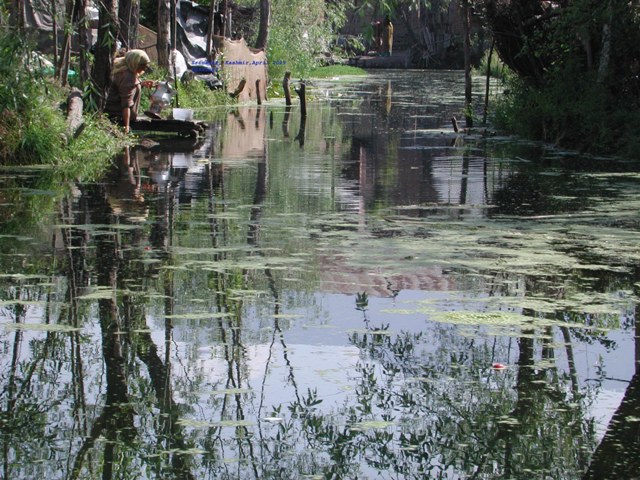
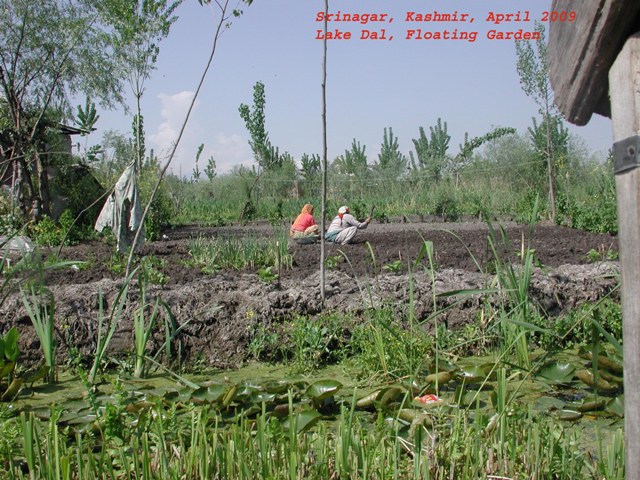 t is recommended to avoid contact with the lake’s muddy bottom, its wild and weird vegetation, the considerable amount of domestic garbage, and the fair level of pollution. The locals do not seem to be too much affected probably because the lack of choice and also because being trained since centuries to take everything with a certain amount of salt.
During the crossing, I am going where? I am strenuously trying to make a contact with my self-appointed guide, who is a beautiful young man (a local striking masculine feature while women are hardly visible or conspicuously hidden), particularly tight-lipped with a cold and unpleasant look. Who summoned him? The rower was not enough? I think it was the houseboat owner who brought him. The taxi driver that took us from the airport, the shikara‘s rower that shipped us yesterday on the barely rippled mirror of lake Dal, the owner of the Star of Kashmir houseboat that swallowed us into its parts, and proprietors the emporium of ethnic arts in which I sunk without seeing any workshop, are links of a Casa Nostra kind web of tourists’ purse hackers.If they aren’t killing anybody, they vigorously pressure everyone. I smell a rat, but is too late. Under my barrage of questions, the “guide” recognizes to be a member of the family owning the emporium, the shikara, the taxi and the houseboat, the invisibles workshops and more. I will visit noles volens the monstruous mercantile unit if I do not want to regain the houseboat Jesus Christ style on Tiberias lake. An emporium of folk arts in India, Kashmir is still a part of it, is a giant concentration of money worth objects that can belong to a cluster of closely related people up to 100 individuals. The problem is where one is located on the totem pole. Finally the young man began to melt and progressively revealed the deep reason of his glumness. He is the third in line from an x number of brothers. The older brothers are married. A wife with complete service, wedding, gifts, singers, dancers, food ( thank God expensive alcoholic drinks are officially banned), imams, fortune tellers, rowers, tailors, flower designers and so on cost 80.000 euros. https://www.youtube.com/shorts/o9lR32CrASA .That in 2009. The family cannot handle another hemorrhage. Why don’t you take a Bangladesh girl I hear me proposing. You should get it at discount price. My twisted scornful advise was adding insult to injury. It is not the wench that is expensive is the complete service.  The young man looks at me with hate. He is hundred percent white Caucasian while she will be more tanned than an overdone pancake. I don’t give a shit about his anger (Sorry, revered guardian angel, I am sure that you don’t suffer from ‘correctness’!).
I will marry with glee concomitantly (I feel a little bit of Muslim myself) a complete rainbow with nor more expense than 1000 euros each time. Pane, fromaggio, vino accompanied by some sitar languorous raga tunes, will amply suffice. May cautious spending with modest behavior go for ever hand in hand especially in matrimony.
We arrived. I dislike emporiums. They are stuffed with thousands of objects. You can barely look to one. Manic vendors are continuously prodding you with small but sharp invisible tridents. They don’t like 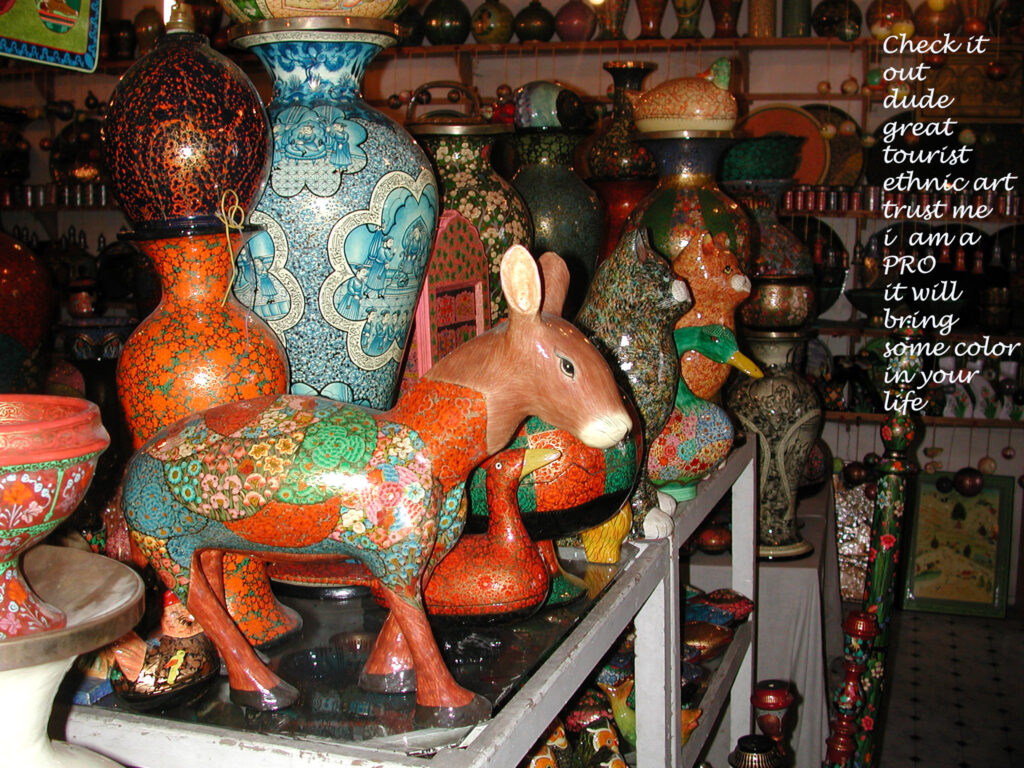 singles, they prefer groups. And they are great for giving you a guilty feeling. A psychological war take place under the open sky. Being a battle tested veteran I try to bring them on the brink of a nervous breakdown by putting stupid questions and suggesting ridiculous prices. At the very end I get the object of desire. Then smiles, good whishes and congratulations
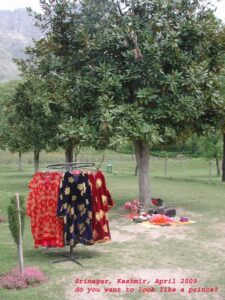
 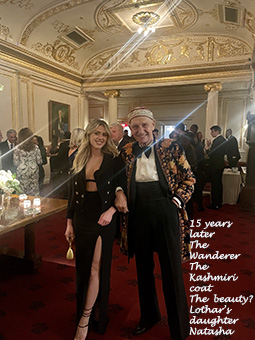 are exchanged. This time was a smashing embroidered coat that I dress anytime I want to offer to people around a discussion topic for a month or two. The craftmanship is superb no matter the material or technique: papier maché, walnut wood, carpet weaving, wool, silk, bronze, ceramic, tissue, glass you name it. The Pachima shawl has conquered the world. I cannot imagine a hottie that doesn’t have it or won’t acquire it tomorrow. The dominant aesthetic mode is horror vacui, i.e ‘fear of empty space’ leading to a decoration that expands over surface patterns, motifs, and images as tightly as pieces of baklava inserted in a baking tray.
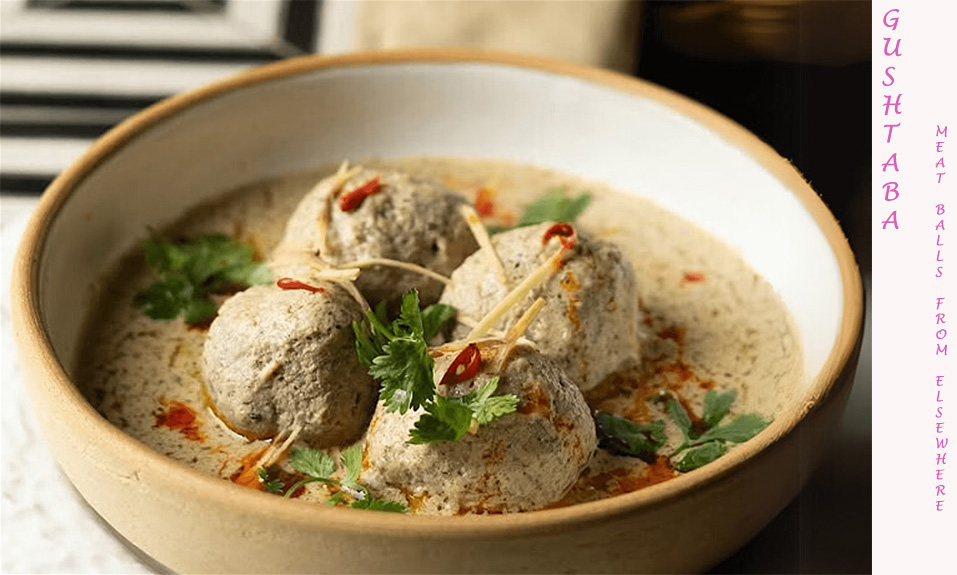
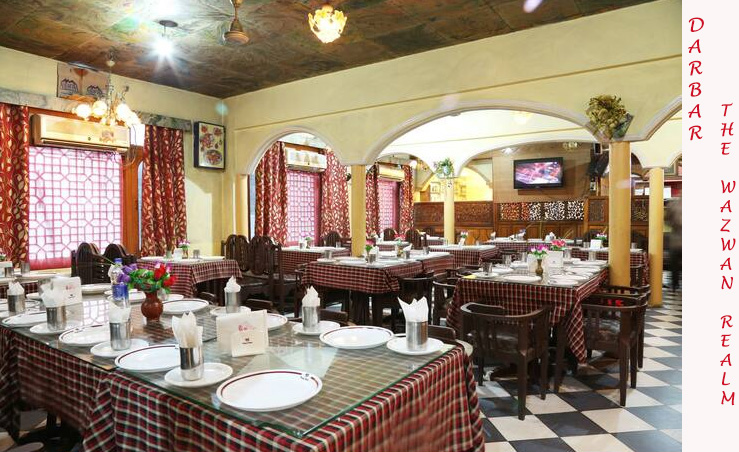
Speaking of baklava makes one hungry or even ravenous, the appropriate state of mind to tackle a monumental Kashmiri set of dishes, from 15 to 25, called Wazwan. https://www.youtube.com/watch?v=Pp3Auuz4ePA&t=326s The set is longly and wisely cocked from various pieces of lamb, beef and mutton first quality meat, plenty of yogurt, some vegetables and an infinity of spices – do not forget that Kashmir is the land of saffron, mostly fake, sold at gold price worldwide.. Since the Wazwan can directly carry one to a gastronomic paradise of flavors or into the hell of intestinal obstruction a potbelly of a capacity close to that of a dentate whale (odontocetes) is mandatory. A regular chap will faint only seeing it. At his best Lothar, who returned safe from the mountains, can stand fort a little whale, but he is not a meat buff. Wisely we settled for the last dish of the set called gushtaba consisting of meat balls, the best I ever tasted in my long life, and a divine gravy. We left Darbar, the temple of local gastronomy with the conscience that we participated to a propitiatory or even initiatory or both meal of the value, I am not exaggerating, the Last Supper.
There is little wonder that after the gastronomic extravaganza we tried to urgently find a source of spirituality to counterbalance our recent excesses. And what can be more spiritual than a tree, especially if it is a national tree like the baobab of Madagascar, the birch of Russia, the marple of Canada, the 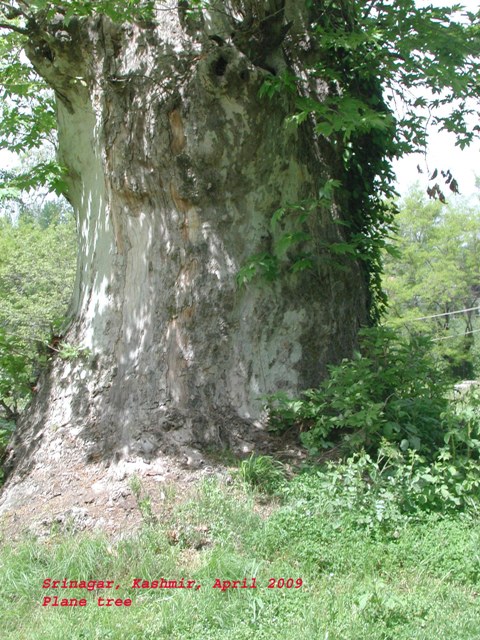 poplar of Romania, the cedar of Lebanon (for what was once Lebanon so to say) etc. Kashmir national tree is a magnificent plane giant called Chinar in vernacular and Platanus orientalis Kashmiriana in the scientific idiom. It is a protected prince. You cannot fell one even if you have to build a road. Go around dude…When we arrived there Lothar made two genuflections and three reverences, I did four genuflections and seven reverences. There is nothing to be done, he can be much stronger than me, I am the flexible one…We did that, I inform you discreetly, to worship the rustic deity living in the national tree or even embodied into it. Of course we have been asking for a little boon..these deities are long life specialists, you understand…
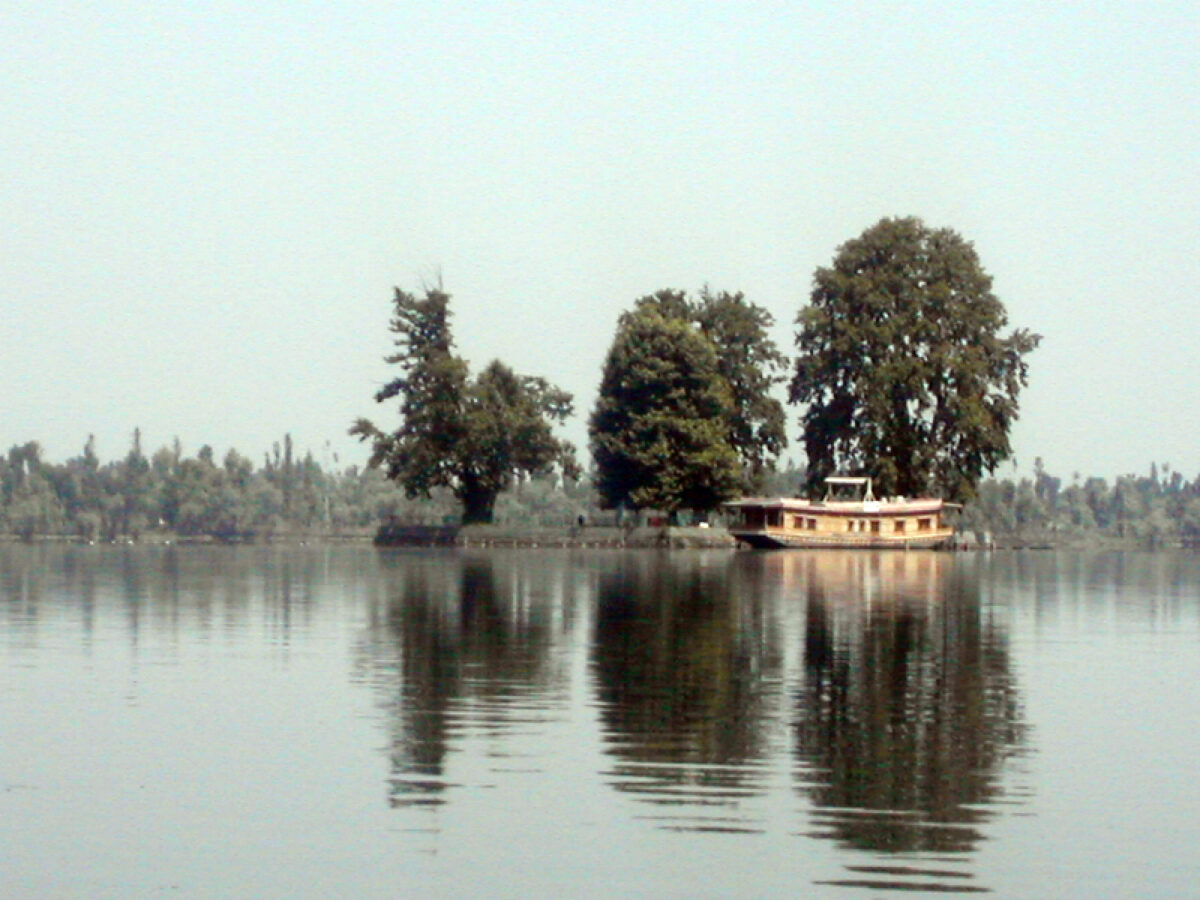
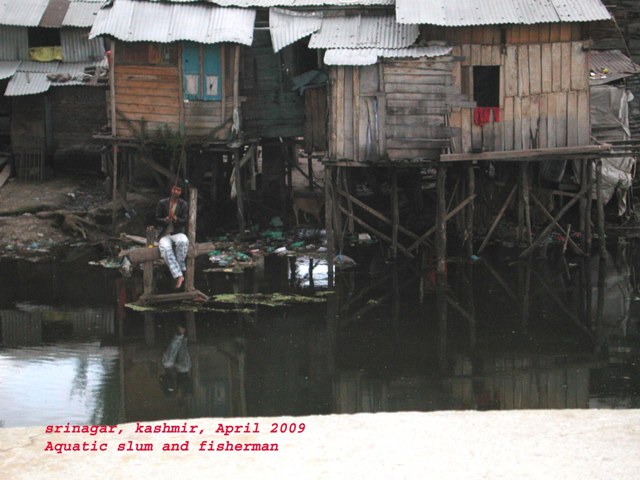
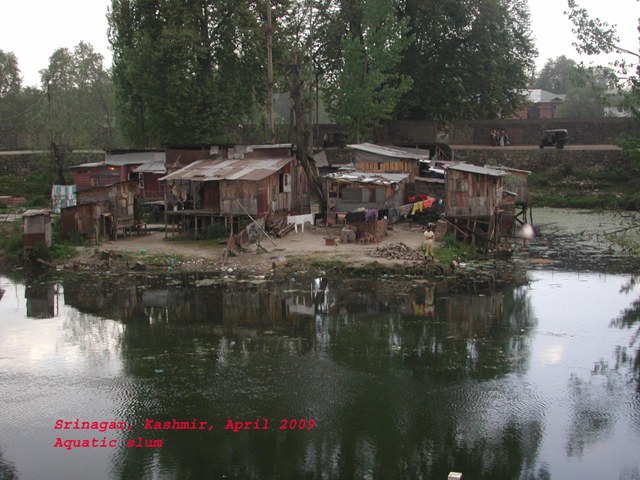
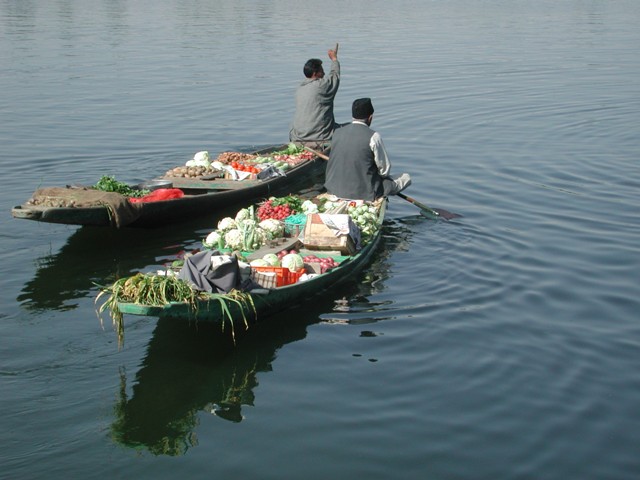
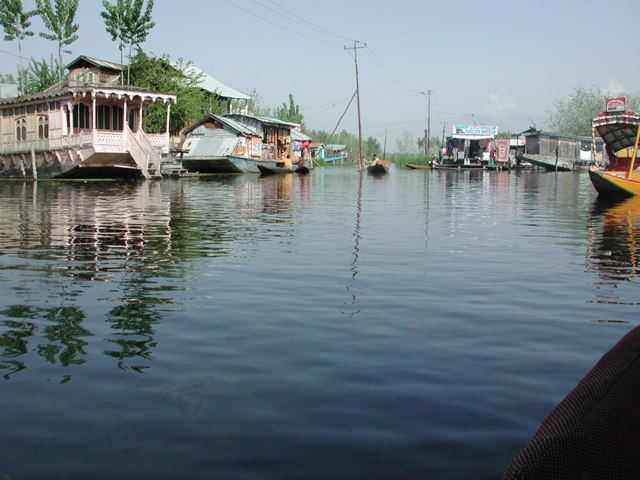
In the after noon, we boarded a low-on-water, very well-balanced shikara and harrowed the blue-green liquid ground in search of exciting finds. There weren’t many, but the smell of authenticity—sometimes pungent—was unforgettable! We passed boats selling vegetables, boats selling house hardware, people-carrying boats, boats selling tourist regalia, flowers and seeds, traditional medicines, outstanding textile outfit of wool and silk (are they all manufactured in Kashmir?), eventually goats—and many others I’ve now forgotten. We visited the cute floating market (more than instrumental for the locals) and went stright for a superb aquatic slum I put an eye on already the yesterday. I must avow: I’m in love with houses on stilts.Their constructivist simplicity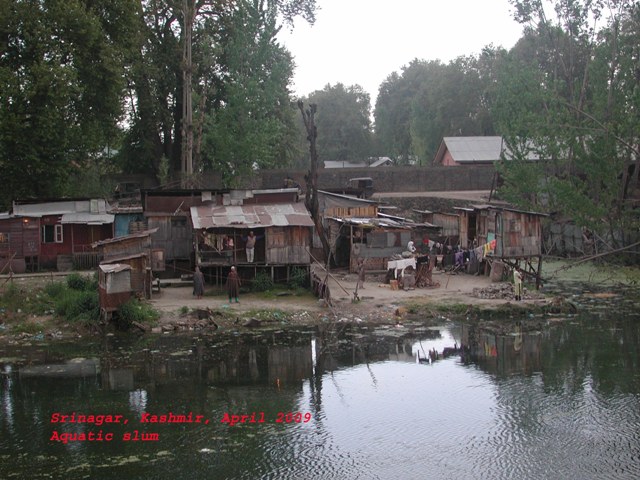 —Tatlin-style—perfectly articulates empty, prismatic spaces. I had visited similar homes in Iquitos, Peru, and was enchanted. Even their miserable
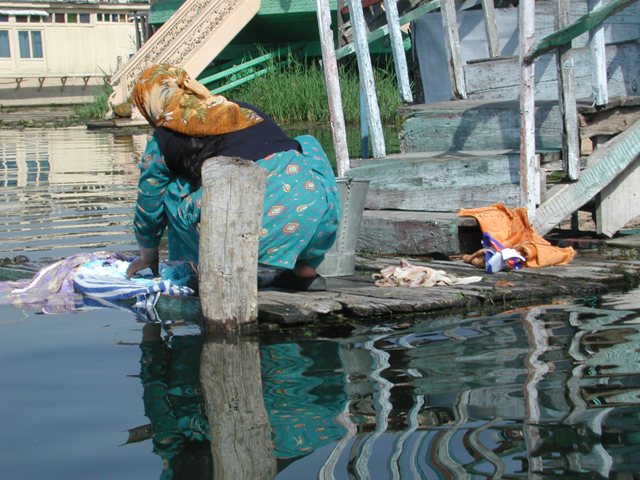
inhabitants, freely delivering their excretions into the primordial waters, seem miles above the homeless derelicts who continuously stain the soil—like mountain gorillas fouling their nests at night. It reminds me of the impish Principal (sorry) who once said: “There are no limits to misery: while you cannot be happier than happy—and only for a brief moment—you can always become more miserable than before, and for your entire life, if it is your lot”.You can trust the Principal for nasty jokes upon poor humans!
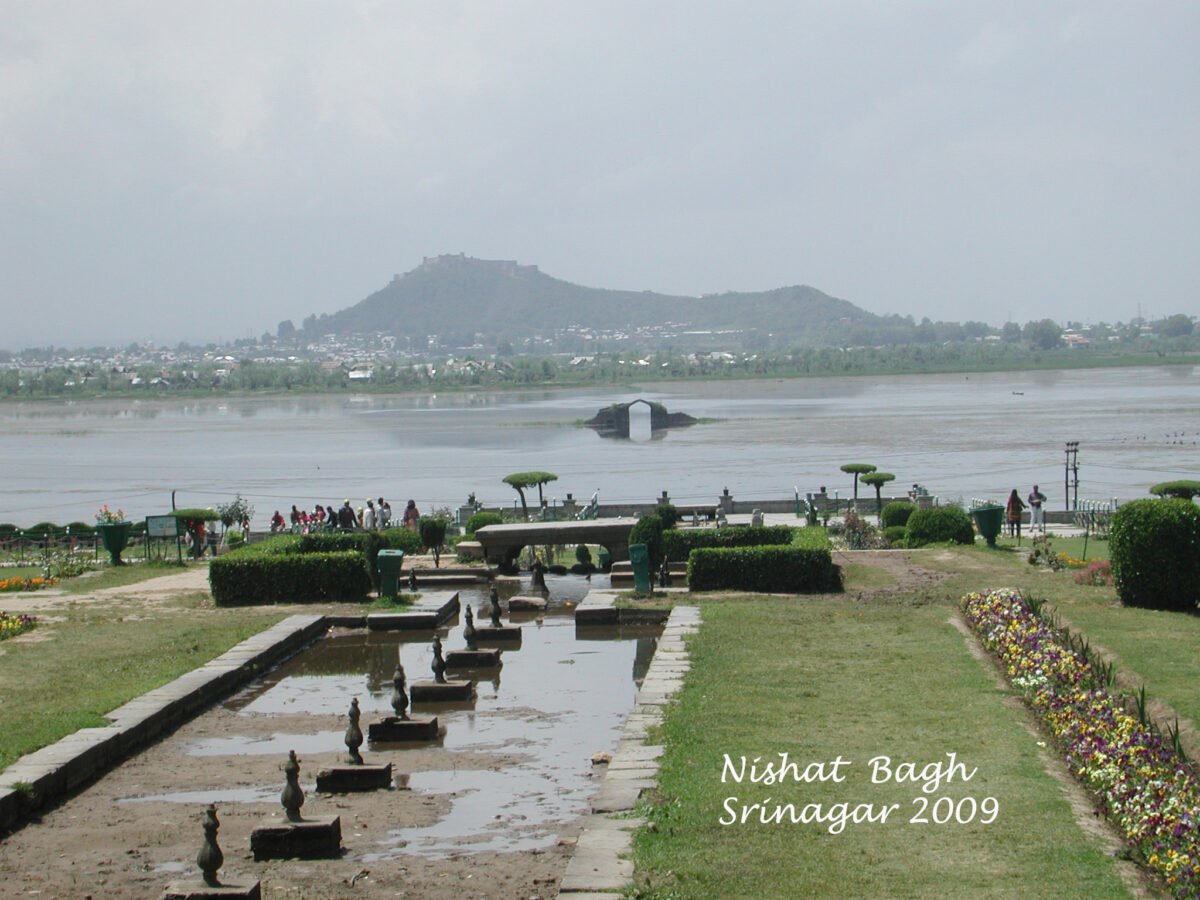
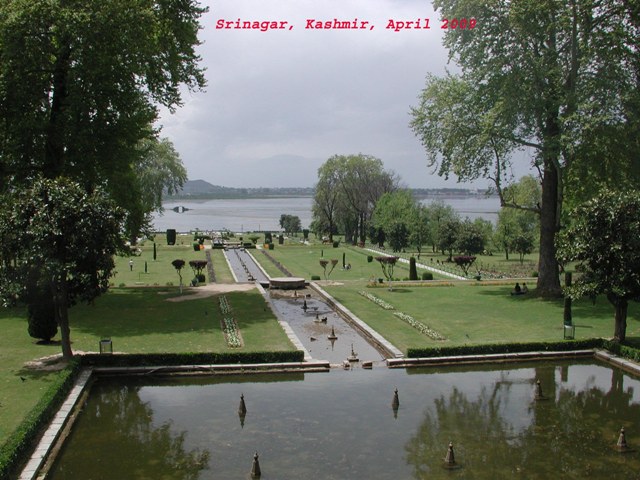
But we had bigger fish to fry and coldly left the lake’s anarchic, entropic ensemble for the realm of order, reason, and poise—namely, the matchless Nishat Bagh Mughal garden. Thank God the Principal endowed me with more patience than brains. Who needs brains, anyway? Mankind is overflooded with that grey, soft, mucilaginous matter—and look where it’s gotten us.
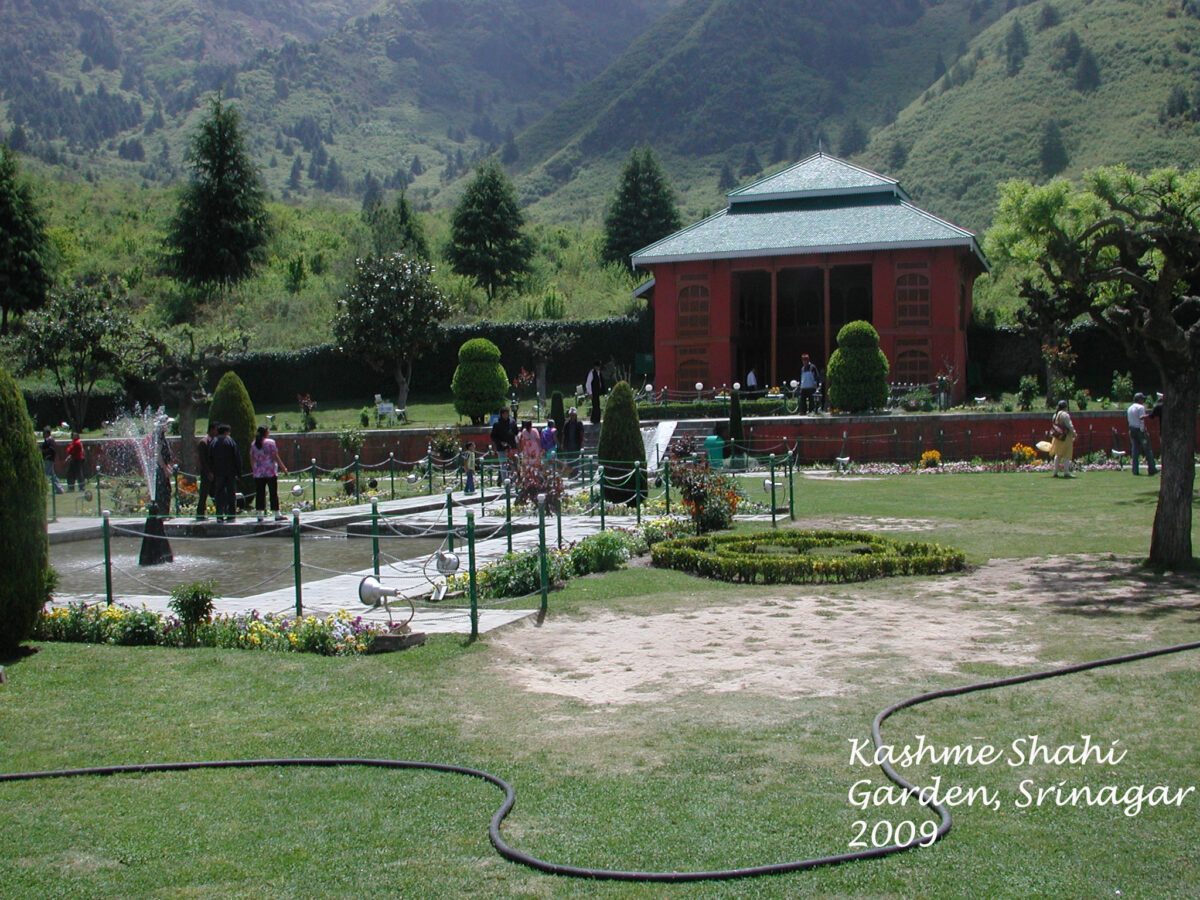
I was about to report on the visit and attempt to capture the aura of a Mughal Garden when I realized the photos didn’t match my notes. Doggedly, I began to sniff around, only to discover that, out of the famous three gardens, we had seen two: Nishat Bagh and Chashme Shahi. Thank God we missed the inspiring Shalimar (what a name—it conquered the world!). Whatever the case may be, I shall restrain myself to a succinct phenomenological or even better, taxonomic depiction of Nishat Bagh, wondering if this task alone is not far beyond my wit and skills.
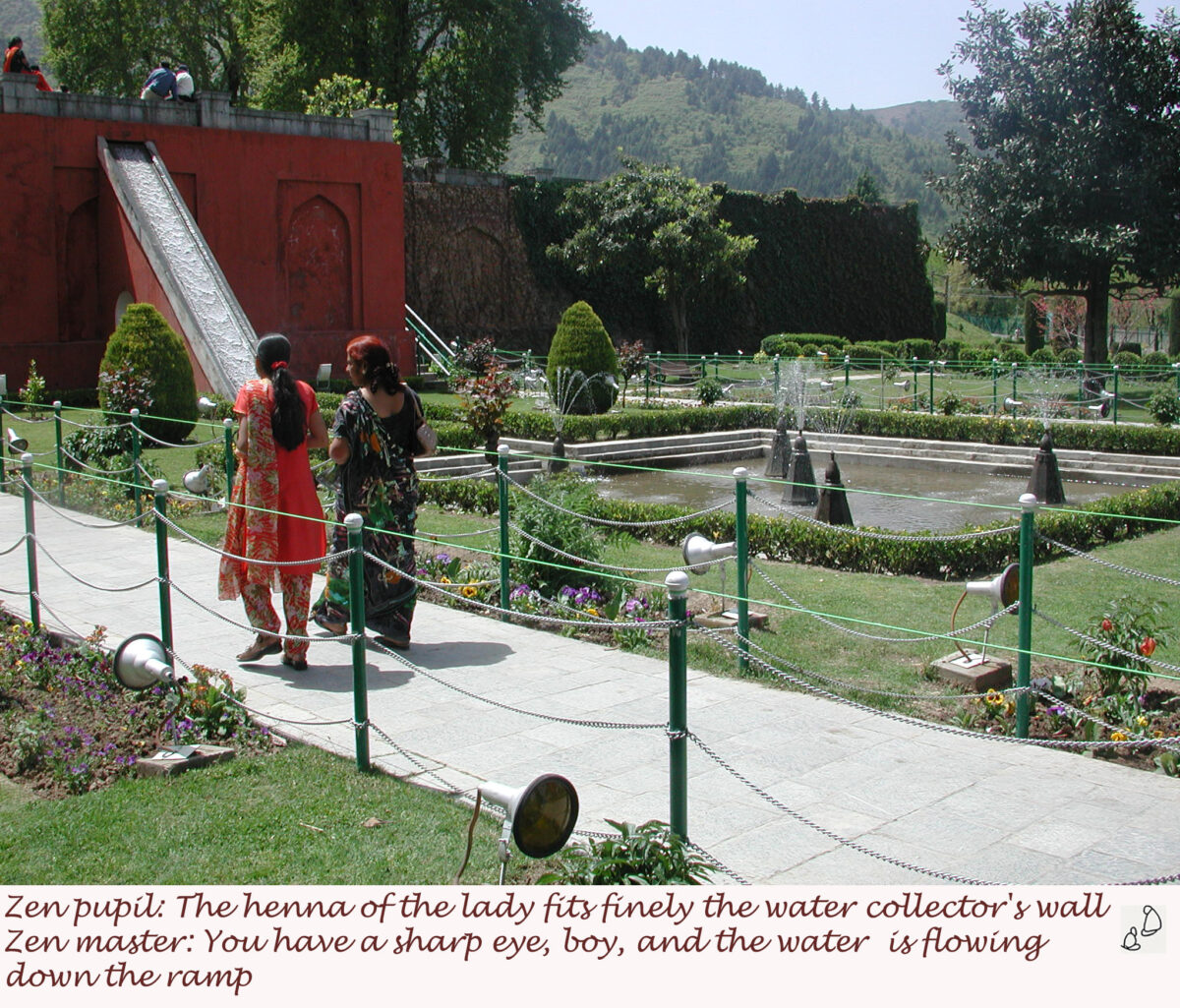
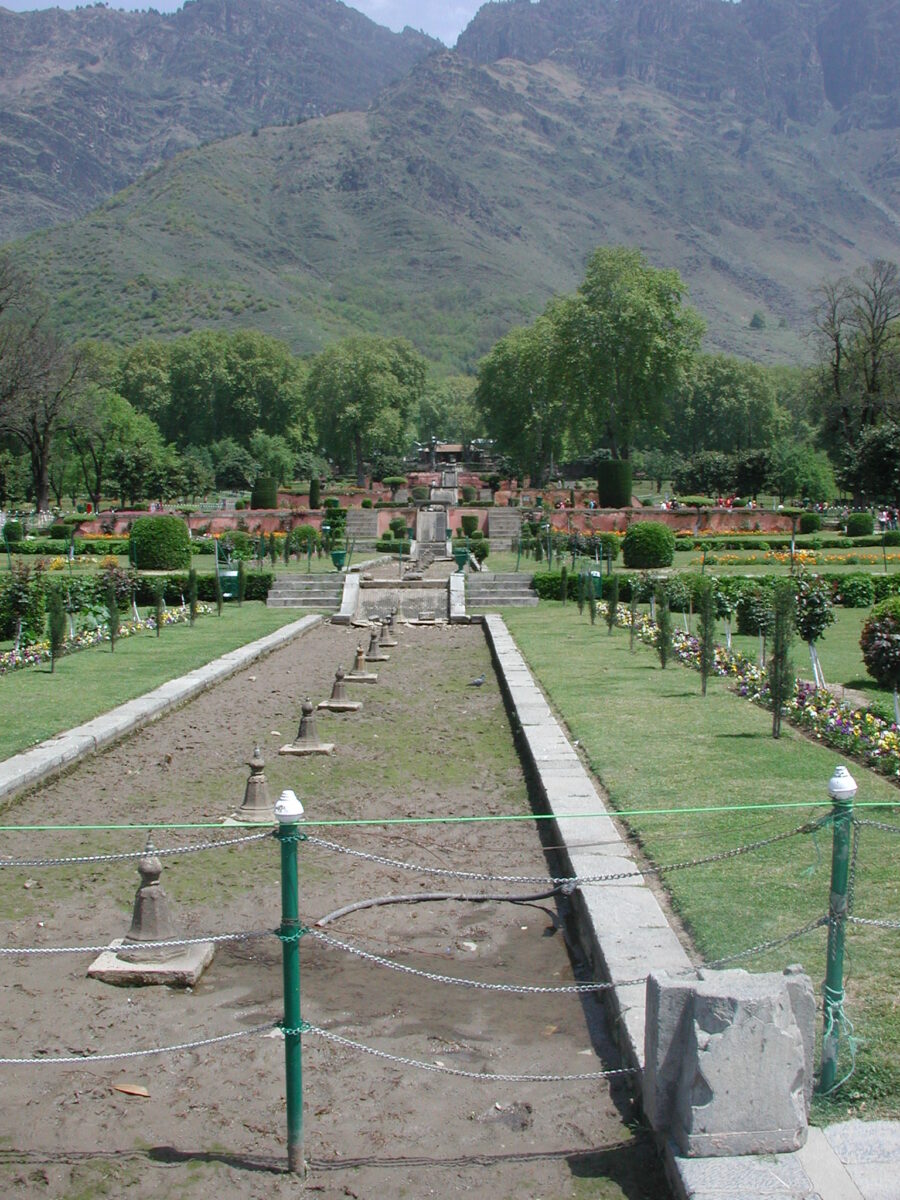
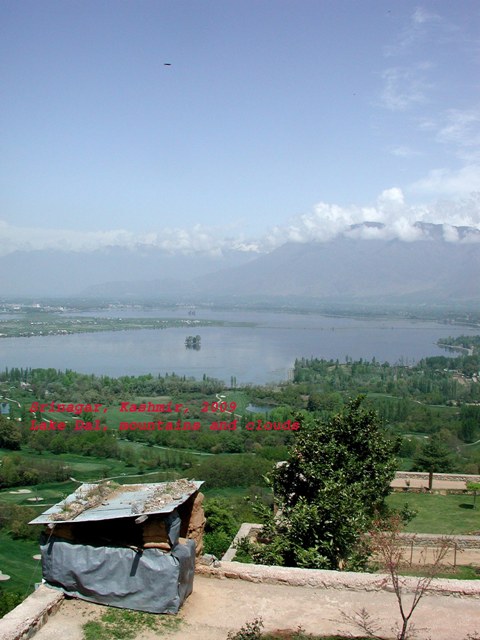
Within the distinctive orographic setting of Srinagar, the defining element of a Mughal garden is the engineered water flow—from a high eastern mountainside to a lower western lakeside. Once this principle is grasped, the rest is refinement. A reliable water source at the upper level is essential. From there, water is guided through a carefully orchestrated sequence of broad and narrow channels, square basins, and cascades of varying scales. It flows past symmetrically placed artesian fountains—either along the central axis of the channels or within the perimeter of the basins— toward the waiting lake. These elements are unified by a polished stone rim, slightly elevated above the waterline, forming a coherent visual and spatial composition.
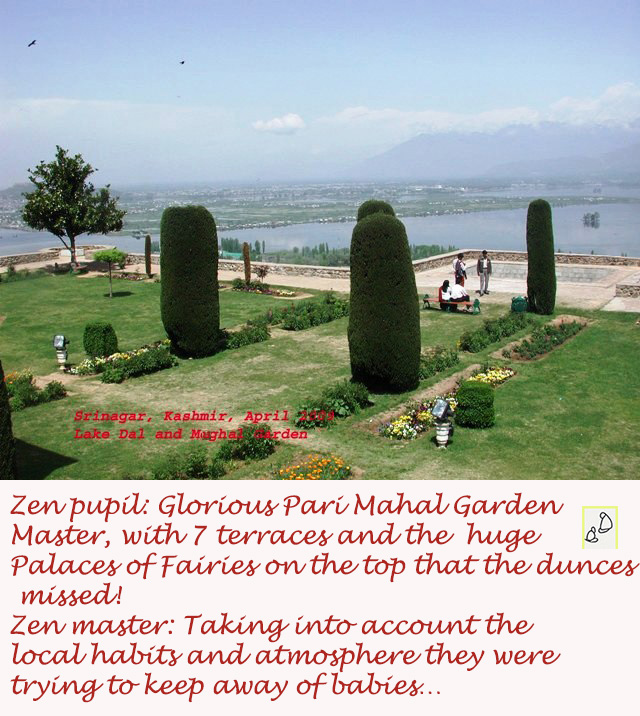
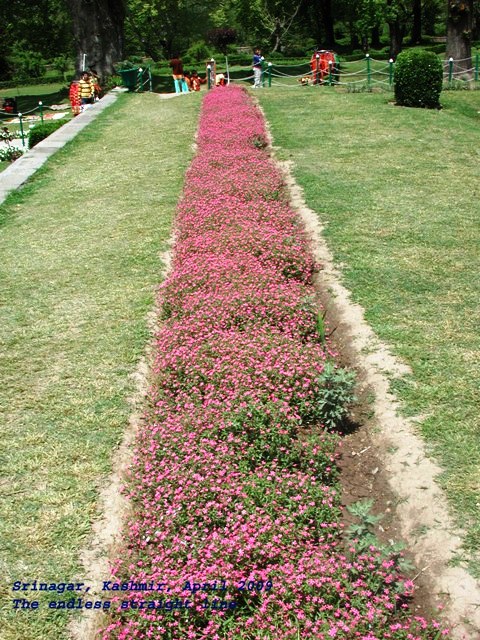
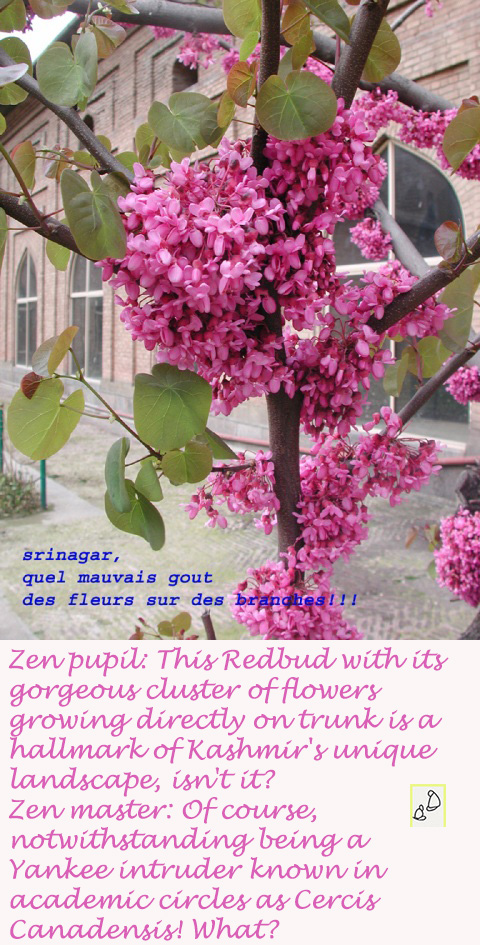
This interplay of stone and water culminates in a strong axial layout, distributed across a series of terraces—twelve in the case of Nishat Bagh—that echo the site’s natural elevation and the staged drops of the water flow. The terraces, connected by stone staircases flanking the watercourse, are adorned with expansive lawns, sculpted shrubs, rows of chinar and cypress trees, and floral beds. The entire design is governed by symmetry and geometric precision—rectangles within rectangles—where the right  angle becomes the ruling principle of order and aesthetic clarity.These gardens are closely associated with Shah Jahan, visionary patron of the Agra’s Taj Mahal and arguably the most remarkable ruler of the Mughal Empire. While the empire (1526-1857) was established by a Persianized Central Asian Turkish-Mongol dynasty that chose Srinagar as its summer capital, a broader historical context, though compelling, may be left aside.What remains is the immediate experience: gardens as serene
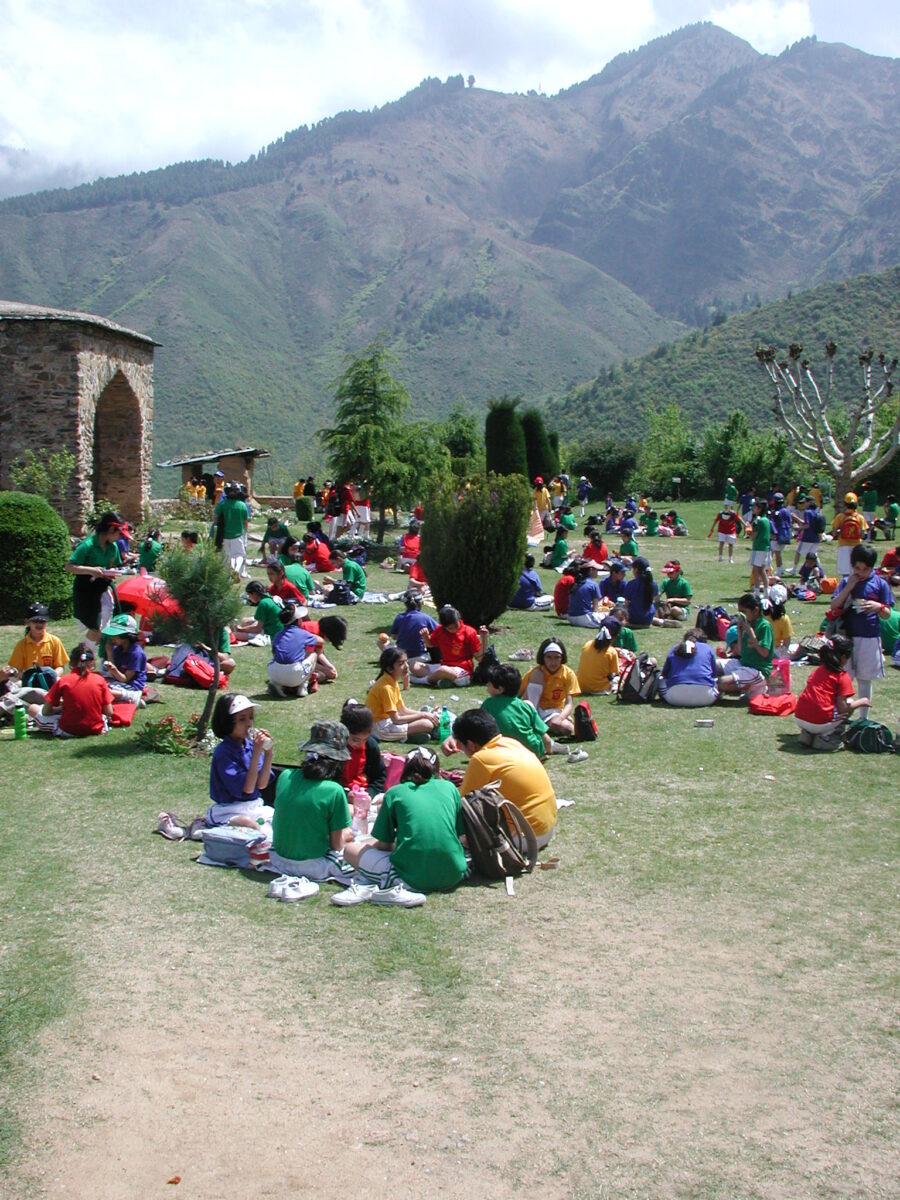
  oasis, ideal for contemplative encounters with curated nature. Today, they attract waves of Indian tourists—eager to share views of snow-capped mountains and flowing water with their children—as well as honeymooners, veteran old couples and visitors dressed in rented Mughal-era costumes to relive a sense of bygone splendor. With a bit of luck, one might also glimpse local women and girls enjoying a rare moment of leisure and freedom (!).
About Post Author
