
To Ladakh by Continuous Prayer, Part Two
The Lamasery
The lamasery, a midway station (for the chosen) between earth and heaven, is a peerless marvel, functionally, technically, symbolically, and aesthetically. Lamaseries have a history spanning millennia. Some, like the Alchi Gompa that we visited, date back to the time of Rinchen Zanag (958-1055 CE), the first translator of Sanskrit Buddhist holy writings into Tibetan. The coevality of the lamaseries in both Grand and Little Tibet suggests that Ladakh is not an offshoot of Tibetan culture but an organic part of it, despite its geographic isolation. So, please do not mistake them for a backwater. Geographically “out,” they are  culturally very much “in.” Moreover, in the wake of Tibet’s so-called “liberation” by the half-Communist, half-Capitalist, fully Imperialist Han, Ladakhi Buddhism has (peacefully) emerged as a spearhead of Tibetan Buddhism. Should the XIV Dalai Lama decide to reincarnate into the XV—it is high time, as the venerable gentleman is already ninety—I would sincerely advise him to choose a male infant (no offense intended, simply a matter of personal choice, for all other positions than Godhead, I prefer women) from Ladakh, rather than Los Angeles, Riyadh or Gongqingcheng, God forbid! Of course, His Holiness is free to do as he pleases…
Ecologists, if sincere, should adore the lamasery concept and its execution. Built of cheap local materials like mud bricks, loam, some stones here and there, timber (reinforcements, dividers and frames), reeds, mortar, and lime paint they are light and solid. The roofs are of wood beams, willow branches, and a conglomerate of soft materials that finally compress into a stronger-than-cement plaque. So long, so good but…
 For a country more naked than a baboon’s behind with small fenced groves (as protection from caprid destroyers) looking like the leftovers of some out-of-business tree nurseries, the wide use of wood in lamasery construction raises some tricky questions. From where did it come? And how was it carried there in the absence of then and even now proper roads for animal transport? Without doubt with skill and patience, and eventually (I cannot attest or infirm—do not forget that we are in a Buddhist metaphysical territory), by telekinesis. The technique is traditionally restricted to saints or holy men, but some exceptions could have taken place when the motivation was spiritual and cultist. That’s all for the moment.*
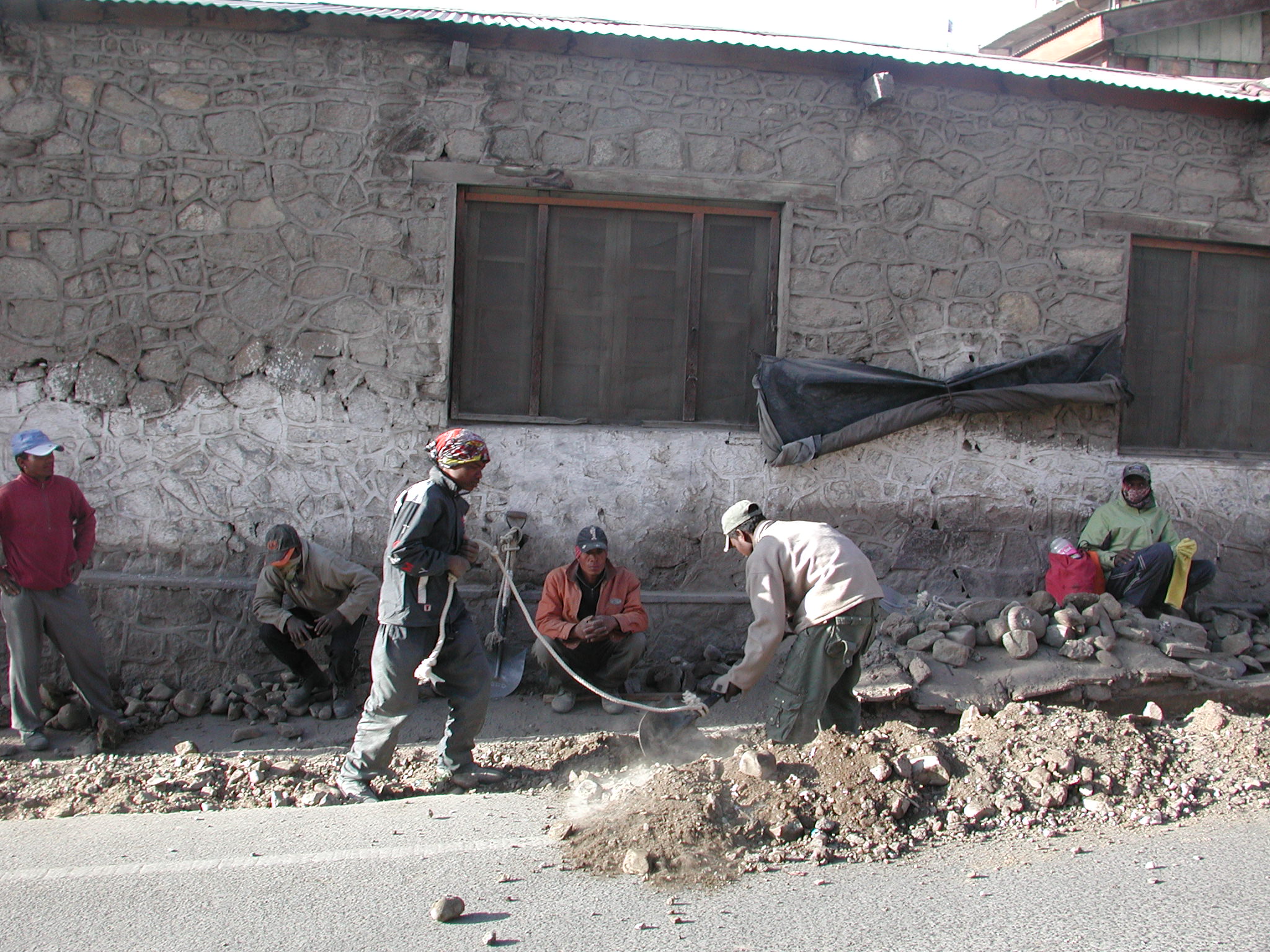
Zen Pupil: Master, I do not understand the Wanderer’s enticement with this example of gross, primitive technology! An air of a well-worn riddle lingers upon this odd grouping  of a rope, a ladle, and dirt. And the cruelty of making public the ordeal of two very young mothers forced into hard labor is shocking.
Zen Master: Careful, young brat. To call someone or something “primitive” today may land you in jail, quicker than raping a granny! This hallmark of Ladakh’s culture is pregnant with multiple messages, such as its heart-moving simplicity contrasting with the complexity of the building process, or the triumph of the inventive human mind in securing the difficult task of keeping the dirt together in a particularly harsh, windy surrounding. All that without mentioning the aesthetic  quality of the composition that led to the creation of an image as close to its own Gestalt as possible! A kind of concrete art! Capisci?
Quite bulky from the outside, the buildings, either dominantly horizontal or predominantly vertical, are perched on the top of a hill or on the edge of a ridge. Despite geometry ruling supreme their insertion within the underlying orographic pattern is astonishing; they seem to grow out of the rock. Their chromatic key is simple and stable: walls are covered by large whitewash surfaces; roof cornices, door and window frames, wooden columns and sometimes a restricted wall surface, are colored in deep red with here and there ochre accents. The lamasery is a compound, often growing by accretion, of halls,  cells, corridors, courtyards, doors, terraces providing magnificent views, strong window sequences, rare green spaces, and a cricket ground to bring solace to the budding monks. Acculturation is the name of the game!
The lamaseries were (in today’s China), and they still are here in Ladakh, the backbone of Tibetan culture, the infallible centenary clock that rules and controls the life of the individual and the rhythm of society. They are also the workshops and the depository of priceless artworks, like paintings on silk, complex painted sculptures carved in wood and yak butter
(oh yeah!) https://www.instagram.com/p/CqBJ29qo1rW/ (one click,or two), large murals and illuminated manuscripts.But storage, as important as it is, is far from being the lamasery’s main function. When I was on my way to hurl this tutti-frutti document through the black hole of the internet mail maw, I felt a sharp itching on the top of my nose. Most probably it was delivered by one of the ectoplasmic taskless Bodhisattvas who are haunting the torturous spatial array of a lamasery. Deeply contrite, I realized that I failed to emphasize the importance of the meeting halls—be they temple, shrine, or general assembly space. They are the energy dynamos of the lamasery, continuously motivating performers and believers within faith and practice, while enticing and fascinating the numerous visitors with a thrilling, vibrant suggestion of another world.
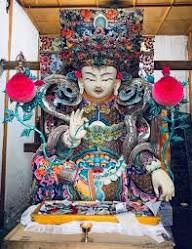
I won’t leave this overcharged raft without mentioning that these sites of living ritual and community gathering are, more so than other lamasery spaces, purposefully and lavishly decorated. They are filled with beautiful, large murals; impressive painted  wood sculptural constructs (like the one illustrated here); and superb Thangkas—paintings on tissue, mostly silk.The sculptural group, created by hired Kashmiri artists, features a central large figure of a blue Buddha surrounded by seemingly hovering and flying mythological beings.
If the wooden construct constitutes a marvelous instantiation of the intermingling between Buddhist and Hindu motifs—somehow evocative of polychrome sculpture groups at the entrance of a Hindu temple—the Thangkas, through both their specific vibrant painting  technique and their frequent representation of the most eloquent motif of the Buddhist World Image (Weltanschauung)—the Wheel of Life—are undisputed representatives of Tibetan Buddhism.
As a whole, space and decoration appear as an attempt to disclose a metaphysical upper reality and to propose a holistic spiritual experience. More I cannot say; a visit is mandatory.
Like the famous abbeys of the Holy Roman Empire (c. 1512 – 1806), the lamaseries house hundreds to thousands of monks. Among them are jacks-of-all-trades such as carpenters, builders, farmers, and maintenance
Joes, and masters in some domains such as schooling, traditional medicine, fine and applied arts, and soul caring (that of the devotee and that of the monk performer concomitantly). The business of meditation is thriving as well with the lamaseries as with the international Yoga corporations (Osso, etc.). Bliss at hand at a discount price is amply provided. A good slice of the monkish folk are practical beggars.
The combination of two major architectural forms—the hall and the tower—characterizes many of the world’s most common religious ensembles, such as churches and mosques. While the hall’s horizontality and spaciousness reflect its communal function, the tower’s condensed verticality symbolically suggests the aspiration toward the upper, spiritual realm.
Within Ladakh’s lamaseries, the giant Maitreya Buddha statues play a role both structurally and symbolically similar to that of the tower or minaret. Their anthropomorphic representation of the savior is far more explicit than the abstract messages conveyed by the tall, geometric forms of a tower or minaret. The message carried by these giant statues—whether placed within monastery complexes, in villages, or at symbolically significant sites—is closely akin to that of the Second Coming of Christ, the Redeemer. Salvation is at hand. Be ready, folks: the wolf and the lamb are going to party, if…The particular monument I wish to discuss, standing 22 meters high, is built of concrete and did not initially appear especially attractive. Its impact emerged later, when the looming, ponderous body was lavishly adorned with vibrant colors, semi-precious stones, gold leaf, and, depending on the lamasery’s wealth, even plates of solid gold. Once completed and glorified, the colossus projects a complex message that combines apotropaic (protective) power, a promise of salvation, and even a feat of optical artistry. Atheists might point out its resemblance to the Golden Calf—but let us set that aside for the sake of the argument.
So far, so good.Yet when I searched Google Images to verify a photograph I took of the Likir Monastery statue in 2009, I found two related but fairly different views. It seems inconceivable that the devout locals would have “killed” one statue to raise another, nor would they have erected two sacred, monumental figures on the same site. The only plausible explanation is that, in the sixteen years since  my photo, they have embellished and significantly enlarged the original statue. Anyone willing to phone the Chief Lama to confirm this deserves a first-rate boon.
Zen novice: Master, once again the Wanderer is missing the point. The difference between the two Buddhas isn’t a question of centimeters or gold ounces. The Buddha that was, it was the Buddha to come: Maitreya; the Buddha that is, it’s Amitabha, the Buddha of infinite light, or the Radiant Buddha. See?
Zen Master (impressed): “Wow! Did you find this by yourself?
Zen Novice: “Yes, Master, with some little help from AI.
 I feel the deprecatory glances of my asshole friend scratching the nape of my neck. I even heard him sneering, “You laid another ostrich egg.” Fuck him, I may lay down a Roc bird‘s egg if I want to. This post is one quadrant of a quadriptych; it couldn’t and it wouldn’t be shrunk. I have three more issues to tackle, and I will do it by hook or by crook.
The Prayer Mill
The prayer mill is a hallmark of Tibetan culture. It is a brass cylinder holding a roll of mantras. Each mantra is a prayer addressed to Buddha and company. Spin it, and you’ve sent prayers heavenward without opening your mouth. As a result, you get a prayer unit in your celestial account. The prayer mill can be a small handled one, like the defective I bought, or a big, massive drum, called prayer wheel, set on a vertical axis at temples entrance. Like the LGBTQ community, I abstain from criticizing cultural norms, no matter how stupid or cruel they may be. However, the habit of mechanically bothering the Buddha and company with continuous prayers and claims reveals a gross lack of class and a high dose of selfishness. Divinities need some free time too otherwise they will perform erratically as it often happens now! Anyway, please do not quote me!
 CODA
CODA
Last night, as I was indulging in a rare, voluptuous sleep devoid of nightmares of any kind, a mighty slap woke me, shaking. The blow was delivered by this weird Bhairava punisher (a dog riding Hindu/Buddhist alternate), who is a fierce emanation of the Bodhisattva Mañjuśrī. “Ignorant worm!” he hissed at my intention while raising his cane in a very convincing manner. “How dare you make fun of the holy concept, custom, rule, symbol expressed by the CONTINOUS PRAYER and embodied within the Prayer Mill? If you don’t want to be reduced to PULP FICTION, write on the spot that the prayer mill is a LIFELINE continuously connecting the believer, the holy writing, the maker, the donor, the matter, the natural forces, and the divinity. Then hit seven times the threshold of this space with your narrow forehead.” Narrow?” If Divinities are flying so low, why wonder when commoners are endlessly offending one another? And I do not have any clearly marked threshold at hand where I live. What is to be done? What is to be done?
Bon cult and banners
Let’s not fear to assert (a necessary change of tone) that continuous praying, either directly or by proxy (wind for example) is an essential feature of Tibetan Buddhism. After arduous research, I am bent to think that Tibetan Buddhism is just Indian Buddhism modified and sensually enriched, if you want, with some tantric approaches and by some Bon cult beliefs and rituals. Considering that for me “live sex on stage” is a tantric approach, I will drop the issue, not because I am a politically correct buff (God forbid), but because my grandchildren don’t need visions of Grandpa in  lurid senescence. That leaves us with the Bon cult, whose power drives such as fortune-telling, soul retrieving, skeletal symbolism and magical intervention seem very much indebted to animistic/shamanistic views of man, life and world.The stripes of fabrics hanging on branches or on plants thorns at old shamanistic cult sites are at the origin of the ubiquitous colorful display of hanging banners in a Tibetan Buddhist area anytime there is a good cable at hand. For what reason? For delivering a wordless load of prayers anytime a strong gush of wind makes them mightily flap. What can i say about this subtle kind of abstract message at cosmic level? Wow!
The climb to summit
At a certain moment of our journey, Lothar proposed and “decided” on a day trip to Khardung La, then advertised as the highest mountain pass (5,602 m) attainable by car in the world. We chose one of the three available days, integrated a caravan, discovered that the majority of travelers were local “commuters,” and understood why the track was passable only three times a week. The other three were reserved for inner-valleys people traveling to Leh. Two vehicles from opposite directions in a side-by-side mode on this road meant certain death; a single one implies that an accident is possible at any time, in any spot. The view was breathtaking, and the weather was Dantesque: sleet from the sky and slush under the wheels. It was not recommended to look into the precipice, and the air was very thin. At a certain moment, not far from the pass, the caravan halted for “good”. The weather changed to colder and wetter. After an hour and a half of marinating, I decided to leave the languid caravan to fade into the fog and began a heroic march (200m) towards the target. The road was bumpy, potholed, slippery, and rough. On the way, Sir Edmund Hillary’s and the Sherpa Tenzing Norgay’s athletic shadows  emerged from the haze to support and complement me. I felt honored and iron-willed. I reached the pass slightly dizzy, soaked in sweat, and wrapped in layers of happiness. I was alone on the top of the world. It was, the highest day of my life. Hi!
One more Roc egg? Undoubtedly! I have to address my sincerest apologies to the learned friend (the former asshole) whose only aim was to make my maculature more readable. I will try to make better (shorter) the next time.
The Wanderer
*Did I raise this question with the intention of sounding clever? It was the result of a fleeting reflection that I had no intention of pursuing. My posts are already overwhelmingly dense. Perhaps I inherited a pinch of my mother’s esper powers. The answer I found was terrifying: huge, devilishly heavy timber was (and still is) hauled in Ladakh by manpower, dragged with ropes along the most unforgiving and dangerous trails imaginable. Each trip is a “double or nothing” gamble with Death. It is also an amazing testimony to what men can achieve when they don’t grow up under the shadow of the social security “teats.” Have a look at this SLiCE documentary and have a heart!https://www.youtube.com/watch?v=YzpT_dgVdTU
Souvenirs, souvenirs – including a younger self


.
About Post Author
