2018, and nail thus, the 80-year time milepost and turning point of sorts! Being a gambler numbers mean a lot to me especially those concomitantly positive and negative. Do not the life’s years signify
 Some who may receive a copy of this letter don’t know who is Danarel. Discreetly, I inform everybody that he is my guardian angel. When it was more or less clear that I should come into being, my mother, the CONJURER, who was also a first rung ESPER (extra sensory perception), a TRUE BELIEVER, and THE LEADER OF THE PEOPLE, did something that had zero chances to succeed. She was desperate. She knew that age and situation, the Second World War was on the way, would not allow her to have more than one child. She also sensates that the package coming, me, will be a quite violent guy, not very easy to raise. Also, she felt that things may go from bad to worse. They did, the Nazis left so to say but the Communist regime that came after was no less ferocious.
 culturally very much “in.” Moreover, in the wake of Tibet’s so-called “liberation” by the half-Communist, half-Capitalist, fully Imperialist Han, Ladakhi Buddhism has (peacefully) emerged as a spearhead of Tibetan Buddhism. Should the XIV Dalai Lama decide to reincarnate into the XV—it is high time, as the venerable gentleman is already ninety—I would sincerely advise him to choose a male infant (no offense intended, simply a matter of personal choice, for all other positions than Godhead, I prefer women) from Ladakh, rather than Los Angeles, Riyadh or Gongqingcheng, God forbid! Of course, His Holiness is free to do as he pleases…
 For a country more naked than a baboon’s behind with small fenced groves (as protection from caprid destroyers) looking like the leftovers of some out-of-business tree nurseries, the wide use of wood in lamasery construction raises some tricky questions. From where did it come? And how was it carried there in the absence of then and even now proper roads for animal transport? Without doubt with skill and patience, and eventually (I cannot attest or infirm—do not forget that we are in a Buddhist metaphysical territory), by telekinesis. The technique is traditionally restricted to saints or holy men, but some exceptions could have taken place when the motivation was spiritual and cultist. That’s all for the moment.
 of a rope, a ladle, and dirt. And the cruelty of making public the ordeal of two very young mothers forced into hard labor is shocking.
 quality of the composition that led to the creation of an image as close to its own Gestalt as possible! A kind of concrete art! Capisci?
 cells, corridors, courtyards, doors, terraces providing magnificent views, strong window sequences, rare green spaces, and a cricket ground to bring solace to the budding monks. Acculturation is the name of the game!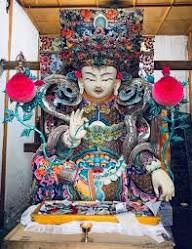
 wood sculptural constructs (like the one illustrated here); and superb Thangkas—paintings on tissue, mostly silk.The sculptural group, created by hired Kashmiri artists, features a central large figure of a blue Buddha surrounded by seemingly hovering and flying mythological beings.
 technique and their frequent representation of the most eloquent motif of the Buddhist World Image (Weltanschauung)—the Wheel of Life—are undisputed representatives of Tibetan Buddhism.
 my photo, they have embellished and significantly enlarged the original statue. Anyone willing to phone the Chief Lama to confirm this deserves a first-rate boon.
 I feel the deprecatory glances of my asshole friend scratching the nape of my neck. I even heard him sneering, “You laid another ostrich egg.” Fuck him, I may lay down a Roc bird‘s egg if I want to. This post is one quadrant of a quadriptych; it couldn’t and it wouldn’t be shrunk. I have three more issues to tackle, and I will do it by hook or by crook.
 holding a roll of mantras. Each mantra is a prayer addressed to Buddha and company. Spin it, and you’ve sent prayers heavenward without opening your mouth. As a result, you get a prayer unit in your celestial account. The prayer mill can be a small handled one, like the defective I bought, or a big, massive drum, called prayer wheel, set on a vertical axis at temples entrance. Like the LGBTQ community, I abstain from criticizing cultural norms, no matter how stupid or cruel they may be. However, the habit of mechanically bothering the Buddha and company with continuous prayers and claims reveals a gross lack of class and a high dose of selfishness. Divinities need some free time too otherwise they will perform erratically as it often happens now! Anyway, please do not quote me!
 lurid senescence. That leaves us with the Bon cult, whose power drives such as fortune-telling, soul retrieving, skeletal symbolism and magical intervention seem very much indebted to animistic/shamanistic views of man, life and world.The stripes of fabrics hanging on branches or on plants thorns at old shamanistic cult sites are at the origin of the ubiquitous colorful display of hanging banners in a Tibetan Buddhist area anytime there is a good cable at hand. For what reason? For delivering a wordless load of prayers anytime a strong gush of wind makes them mightily flap. What can i say about this subtle kind of abstract message at cosmic level? Wow!
 emerged from the haze to support and complement me. I felt honored and iron-willed. I reached the pass slightly dizzy, soaked in sweat, and wrapped in layers of happiness. I was alone on the top of the world. It was, the highest day of my life. Hi!


 déclarée avec le désir de devenir prêtre catholique ! Est-ce une tradition ? Certains le prétendent. Il paraît, d’après les modernes, que la tradition — quelle qu’elle soit — justifie certains écarts, comme par exemple un dépucelage en masse des donzelles au Paradis par un fidèle encore chaud qui vient d’arriver. Va savoir ! Le héros du livre est encore plus riche en identités alternatives — mort et vivant à la fois, voyageur dans le temps, etc. — que son auteur protéiforme. Rolfe, manifestement influencé par l’intrigue du second Faust (autre singularité étonnante), achève brusquement et hermétiquement son histoire, laissant le lecteur bredouille.
 Le lendemain, grâce aux bons offices de mon copain Jack — un jeune Cachemiri rusé au visage de fouine travaillant à l’hôtel, qui me trompait régulièrement (mais pour la sympathie,
  il faut payer) — je fus installé, muni d’instructions pléthoriques, dans le rickshaw de « my man » pour aller chez les Onze. Nous sommes bien à New Delhi, oui ? « My man », bien sûr, m’emmena au diable vauvert.
 guêpier je m’étais fourré… malgré avoir, ce matin-là, comme à mon habitude, invoqué le soutien du Principal. Hélas, les dieux partent souvent en vacances.
 Indira, Kali-Durga pour les ennemis… Elle gouverna par la trique et mourut par les balles…
 conduite par Gandhi en 1930 pour protester contre l’augmentation du prix du sel — formule souveraine pour démarrer une révolution — et qui marqua, sur le mur de l’Histoire, la fin prochaine de la puissance anglaise en Inde.
 hautes du double de la taille naturelle, évolue en file indienne, tout en étant solidement ancré dans le support.


 en revanche, malgré la grosse croix sur la soutane, reste une énigme : lutteur de foire ? Sumo rikishi déguisé en cardinal ? On n’a jamais vu ça ! Quoi qu’il en soit, avec un tel tonnage, on marche à peine.
 et certains Indiens se sont enrichis, sur place et à travers le monde, succès mesurable immédiatement et en centimètres. Pendant ce temps, l’impotent numéro onze, qui rechigne à se lever, incarne le cul-terreux national : agricole, affamé, hindouiste acharné, cruellement privé de protéines animales. Il est là, et las.
 photo qui prouve le contraire. »
 compte, bidule, ver de terre, de l’honneur que je te fais ? Fils de chien ! Islamophobe écorné ! Tu présentes la Partition comme une solution salutaire, alors que plus de deux cents millions de frères sont restés prisonniers de cet État fantoche, réactionnaire, extrémiste, raciste et sous-développé ? Sans la Partition, avec les croyants locaux et les frères Bengali de bonne foi, nous les aurions bouffés, bidule, bouffés ! »! »
 Tayyabji, Upadhyay, et la poétesse héroïne Sarojini Naidu, (à un mètre vingt derrière le Babu…). »

 gravée dans ma mémoire. Elle marque (2013) la fin de mes aventures dans un pays que j’ai visité avec enthousiasme et imprécations, à plusieurs reprises. Elle abritait un ensemble — assez mal entretenu — de sculptures mégalithiques uniques au monde. Enveloppées dans un mystère épais par le manque de savoir sur la cause, la signification, la date de leur création et leur étonnant arrangement en pièces d’échiquier, ces œuvres fabuleuses n’attiraient que quelques touristes endurcis grâce à la forme phalloïde de la majorité des monuments.
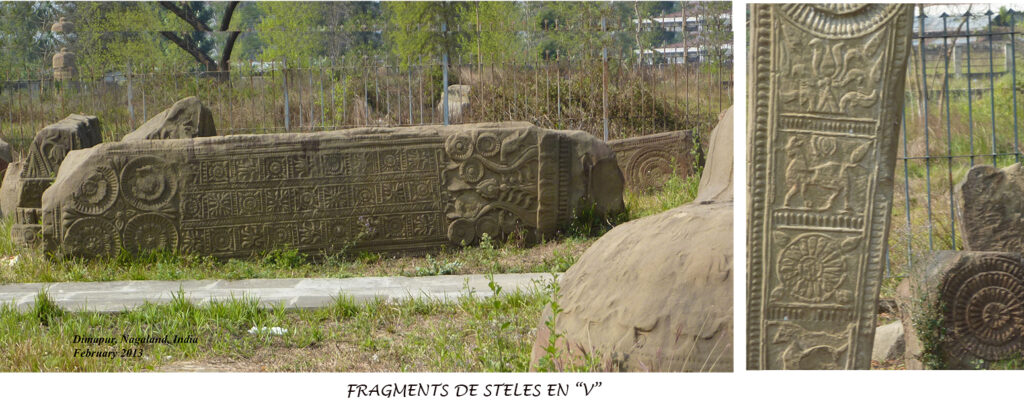
 héraldiques en bas et haut-relief.
 Kachari, ou des portraits stylisés de souverains réunis dans une galerie de famille tridimensionnelle !! Dommage qu’on ait dû abandonner l’hypothèse phallique dans un pays où la représentation du membre divin (Shiva) a touché des sommets de stylisation ou du réalisme. En fin de compte, il faut reconnaître qu’on ne sait fichtre rien, ni sur le projet ni sur sa signification. Je ne vois pas d’autre alternative que de me citer, avoir dit une fois que : « L’art cache infiniment plus qu’il révèle ».
 la seconde capitale des Kachari, véritable perle artistique, est un autre exemple de la difficulté d’approcher cette étonnante culture dans une perspective historique ou fonctionnelle cohérente.
 à l’aube et le temple resta en l’état ; qu’il fût intentionnel ou le résultat d’une banale interruption des travaux. Cela devait se passer dans le premier quart du XVIe siècle.Manque de pot pour le folklore : des inscriptions sur les parois attribuent ce produit cultuel de première importance au roi de Khaspur (la troisième capitale), Haris Chandra, qui l’acheva — façon de parler — dans le premier quart du XVIIIe siècle.


THE WANDERER
I was born with open eyes, shouting; I vainly tried to close them at once. Life appeared ridiculously short, meaningless and the departure often repelling. Mankind was recurrently mad and aggressive.
Action was required imperiously! To invest a little bit in love, the mass of a neutron star, divided by X; some more in friendship, stay curious of art and sciences, mix nature with pleasure, move frequently, consider laugh the uppermost commodity and fun the holy of holiest. Insure an express and voluntary demise and write a blog …
Dear Friend and Frienda*
Dear Friend and Frienda*
Would you like to see the blog’s feature image, the feature image of each post, and (in progress) each image embedded in the texts in full screen? The kind of big is beautiful? Want you to possibly enjoy in full screen each gallery photos in a colorful slideshow galop? Just click once on the object of your desire, once again on the three dots located at the upper right corner of your browser, and then press the incomplete square at the end of the zoom quote. Alas, the increase in size reveals sometimes the lower quality of the photo. Nothing better than leaving the mode by touching the center of the upper side of the screen with your mouse tip. An X sign drops from the sky, click on it and you are out of the monumental.
I began to insert videos and music clips in my posts. If after seeing or listening to a clip you are motivated enough to go back to the post, please, click the arrow situated at the high left corner of the screen. This until I will find a smarter way. So long!
*N.B. I am just trying to introduce this most necessary word into the common body of the English language